


A semistructured database,
 ,
consists of a set of nodes, V, a set of
labeled, directed edges, E, a single root node,
,
consists of a set of nodes, V, a set of
labeled, directed edges, E, a single root node,
 ,
and a collection of so-called property operations,
,
and a collection of so-called property operations,  ,
that
determine the semantics of properties. We also define
,
that
determine the semantics of properties. We also define
 to be the set of edges emanating from
 .
(These edges lead to what would normally be considered the
roots of the semistructure; the extra level of indirection serves
to record the properties of the root nodes.)
An edge in E from node v to node w with the label
.
(These edges lead to what would normally be considered the
roots of the semistructure; the extra level of indirection serves
to record the properties of the root nodes.)
An edge in E from node v to node w with the label  is
denoted
is
denoted
 .
is a label with
properties.
.
is a label with
properties.
[Label with properties]
A label with properties, ,
is a set of m pairs,
 ,
where
(i) each pi is the name of a property,
(ii) xi is a value drawn from the property's domain,
that is
,
where
(i) each pi is the name of a property,
(ii) xi is a value drawn from the property's domain,
that is
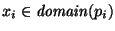 ,
(iii) property operations exist in
for each pi, and
(iv) each property name is unique,
that is,
,
(iii) property operations exist in
for each pi, and
(iv) each property name is unique,
that is,
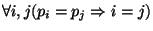 .
.
A required property, say pi with value xi, is
denoted
 .
.
 2
2
Figure 2, an edge connects
&movies to &Color of Night.
The label is the set of properties
{(name: movie), (security! over 18)}.
The security property is a required property.
It is intended to limit access to the node to individuals over
18 years of age.
2
To accommodate properties in queries, several operations for each
property are needed, namely property collapse (
 ),
property match (
),
property match (
 ), property coalesce
(
), property coalesce
(
 ), and property slice (
 )
(see
Section 3.2). These operations determine the
semantics of properties and are included in .
)
(see
Section 3.2). These operations determine the
semantics of properties and are included in .
[Property operations]
For each property p in a label, operations with the following
signatures should be present in .
For brevity,
let T be
 .
.



 2
2
These operations collapse, match, coalesce, and slice property values.
New properties may be introduced at any time by registering the appropriate operations with the database. Default semantics are available for the operations, as will be discussed in Section 3.4.2. Table 1 lists operations for one possible implementation of the properties discussed in this paper. The role of the property operations will become clear when querying is considered, next.


